
The Scottish Government have published the results of a recent study they commissioned that looked into assessing the potential health benefits of further policy actions affecting domestic solid fuel burning in Scotland. Three options were take forward for more detailed modelling, one of which was “Burning Better”. Here’s why that is not a solution that should be contemplated.
Burn Better is a myth that has been circulating for some time: the problem is that whenever anything is burnt, chemicals are released. Below are three reasons that show that burning better is not a good option.
- For modern stoves (including a Blue Angel stove), PM2.5 emission factors are higher for dry wood than for seasoned wood.
- A 2025 University of Surrey study found that multifuel Ecodesign stoves emit more ultrafine particles than a standard Ecodesign stove, and wood briquettes and smokeless coal increased ultrafine particle exposure by 1.7 and 1.5 times, respectively, compared to seasoned wood.
- This report shows, an Ecodesign stove has an estimated emission rate of six times the mass of PM2.5 than a diesel Euro 6 HGV
Burning dry wood is not better
Burning dry wood in modern, efficient wood-burning stoves can paradoxically result in high counts or specific spikes of Ultra Fine Particles because clean, hot combustion breaks volatile gases down into microscopic particles less than 100 nanometers wide. So even though wet wood produces much more visible smoke and larger fine particulate mass dry wood produces lots of Ultra fine particles are very bad for our health and invisible to the naked eye.
Burning wood increases lead pollution in the air too. Trees have uptaken lead from the soil and into their tissues. For many decades we used leaded petrol and this lead is still in the soil and will continue to be in the soil for hundreds of years. That lead is released into the air when those trees are burned – whether the wood is wet or dry is irrelevant.
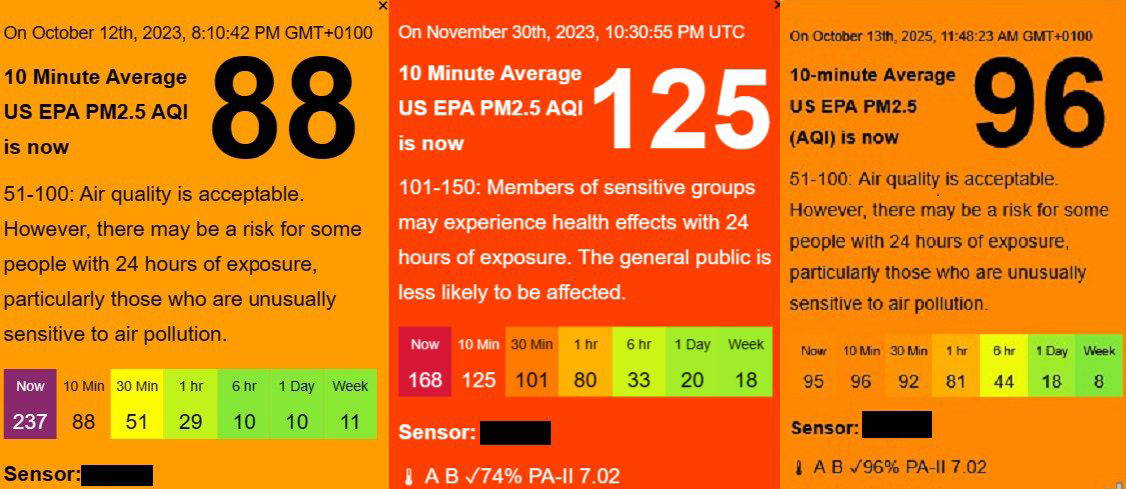
Below are the readings taken from an air pollution sensor located on the side of the house next to a woodburning stove user. These are from a user burning DRY WOOD on a woodburning stove that was installed in 2015. As can be seen there are significant levels of PM2.5 being released for prolonged periods of time.
Burn less
The only solution for better health is to not burn at all which we know if impossible for some properties in Scotland so the better option that the Scottish Government should adopt is to BURN LESS. Krakow in Poland started cracking down on the burning of solid fuels in 2013 by subsidising a switch to cleaner forms of heating and replacing dirty stoves. The full ban on solid fuel burning came into effect in 2019. This has saved 5,897 lives over a decade, according to the European Clean Air Centre.
Marcel Mazur’s research has separately shown that there were 17% fewer cases of asthma and 28% fewer cases of allergic rhinitis in children in 2018 than in 2008.
This progress was a result of rare consensus from all political parties who all understood the urgent need for clean air. This is what the Scottish Government should be doing to protect the health of its citizens. To do otherwise is negligent.