
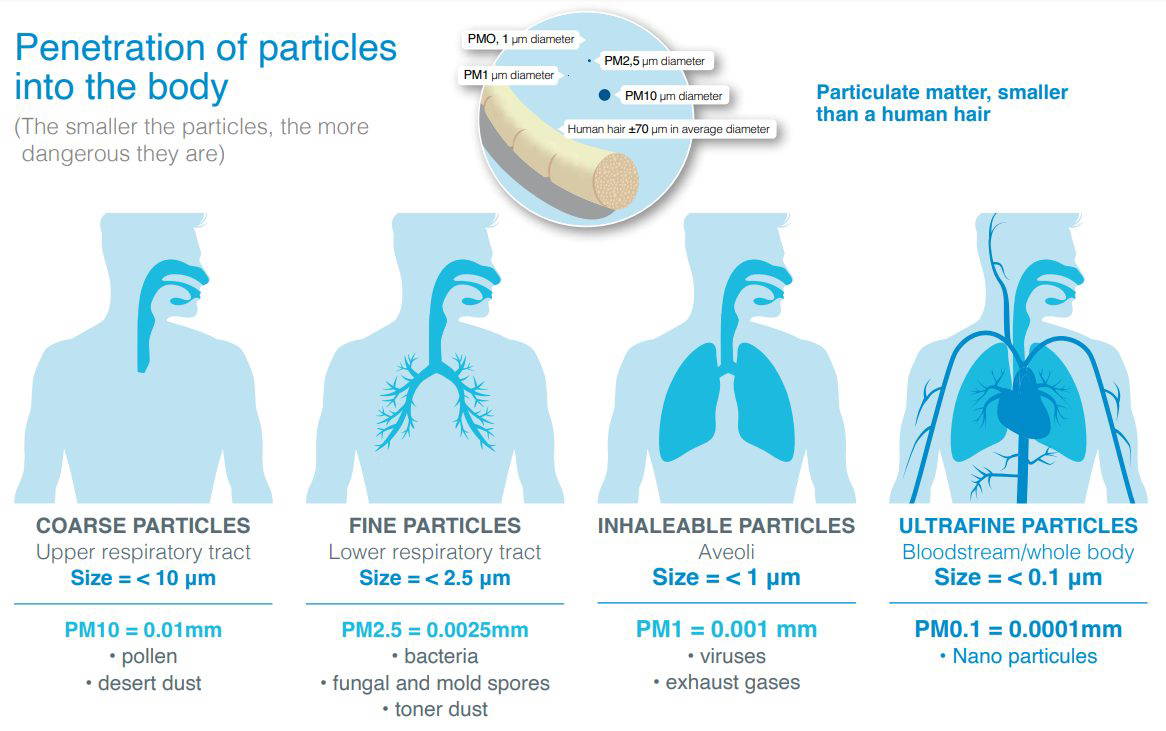
Ultra Fine Particles are roughly 700 to 1,000 times thinner than the width of a single human hair but extremely harmful to our health. They are produced when dry or wet wood is burnt and are abundant in woodsmoke.
Once inhaled, ultra fine particles can enter the bloodstream, and they can become embedded in virtually any cell or organ of the body.
They can also travel up through the nose and, rather than passing down into the lungs, be delivered directly into the brain and central nervous system via the olfactory nerve, bypassing the body’s protective blood/brain barrier.
A recent study from University of Surrey found that many newer styles of wood burning stoves produce more UFP than older style stoves. Burning wood briquettes and smokeless coal increased ultrafine particle exposure by 1.7- and 1.5-times, respectively, compared to seasoned wood, challenging assumptions that these manufactured fuels are cleaner alternatives.
The science is clear. Woodsmoke is hazardous to our health and neither ourselves nor our children should be exposed to this largely avoidable health hazard unnecessarily but sadly in any neighbourhood with wood burning stoves, that is unfortunately currently the case.
Below are just some of the research articles that have been undertaken that show us how bad UFPs are for our health.
- Bächler, P. et al. (2026). UFP, BC, and PM2.5 measurements and the effect of dispersion conditions on concentration levels in a residential area affected by wood smoke pollution from domestic heating during the winter months, Aerosol Research, 4, 63-80. https://doi.org/10.5194/ar-4-63-2026.
- Rajzer, M. et al. (2026). Ultrafine particles (UFPs): rethinking air pollution risk. Cardiovascular Research, 122, 12, 1546-1547. https://doi.org/10.1093/cvr/cvag161.
- Movahhedinia, H. et al. (2026). UFP formation across urban and background sites: Insights on Midday Pollution events through analysis of locally emitted pollutants. Atmos Env, 373, 121917.
- Morawska, L. et al. (2026). Ultrafine Particles in Ambient and Indoor Air: How Our Knowledge Has Evolved from 1990 to 2025. Environmental Science & Technology, 60, 8.
- Lin, C. et al. (2026). Low-smoke fuels for residential heating linked to an increase in ultrafine particle (UFP) emissions. Nat Geosci, 19, 447-454. https://doi.org/10.1038/s41561-026-01942-1.
- Nenon, D. et al. (2025). Mortality risks associated with short-term exposure to ultrafine particles (UFPs) in London and West Midlands. Env Epidem, 10, 1, e449. Doi:10.1097/EE9.0000000000000449.
- Garcia-Marlès, M. et al. (2024). Source apportionment of ultrafine particles (UFPs) in urban Europe. Environ Int, 194, 109149. https://doi.org/10.1016/j.envint.2024.109149.
- Zhang, J. et al. (2024). Adverse effects of exposure to fine and ultrafine particles (UFPs) in the environment on different organs of organisms. Journal of Environmental Sciences, 135, 449-473.
- Weichenthal, S. et al. (2024). Long-Term Exposure to Outdoor Ultrafine Particles (UFPs) and Black Carbon and Effects on Mortality in Montreal and Toronto, Canada. Res Rep Health Eff Inst. 217, 1-63.
- Rowell, A. et al. (2024). Insights into the sources of ultrafine particle (UFP) numbers at six European urban sites obtained by investigating COVID-19 lockdowns. Atmos Chem Phys, 24, 16, 9515-9531.
- Dada, L. et al. (2024). Sources of ultrafine particles (UFPs) at a rural midland site in Switzerland. Aerosol Research, 3, 315-336. https://doi.org/10.5194/ar-3-315-2025.
- Schwarz, M. et al. (2023). Impact of Ambient Ultrafine Particles (UFPs) on Cause-Specific Mortality in Three German Cities, American Journal of Respiratory and Critical Care Medicine, 208, 10, 1334-1344. Doi:10.1164/rccm.202209-1837OC
- Jeong, S-G. et al. (2023). Size-resolved emission rates of episodic indoor sources and ultrafine particle (UFP) dynamics. Environmental Pollution, 338, 122680.
- Audignon-Durand, S. et al. (2023). Indoor exposure to ultrafine particles related to domestic activities: a systematic review and meta-analysis. Sci Tot Env, 904, 166947.
- Poulsen, A.H. et al. (2023). Source-Specific Air Pollution Including Ultrafine Particles (UFPs) and Risk of Myocardial Infarction: A Nationwide Cohort Study from Denmark. Environ Health Perspect, 131, 5, 57010. Doi:10.1289/EHP10556.
- Nair, A.A. et al. (2023). Environmental exposure disparities in UFPs and PM2.5 by urbanicity & socio-demographics in New York 2013-2020. Env Res, 239, 2, 117246. Doi:10.1016/j.envres.2023.117246.
- Kuye, A. & Kumar, P. (2023). A review of the physicochemical characteristics of ultrafine particle (UFP) emissions from domestic solid fuel combustion during cooking and heating. Science of The Total Environment, 886, 163747.
- Kobolova, K. et al. (2022). Ecotoxicity of fine and ultrafine particles (UFPs) released from biomass combustion. doi:10.5593/sgem2022V/4.2/s19.30. Proceedings of 22nd International Multidisciplinary Scientific GeoConference (SGEM) 2022.
- Robinson, P.D. et al. (2022). UFP exposure and biomarkers of effect on small airways in children. Env Res, 214, 1, 113860. Doi:10.1016/j.envres.2022.11386
- Weichenthal, S. et al. (2022). How low can you go? Air pollution affects mortality at very low levels. Science Advances, 8, 39. Doi:10.1126/sciadv.abo3381.
- Groma, V. et al. (2022). Sources and health effects of fine and ultrafine aerosol particles (UFPs) in an urban environment. Atmospheric Pollution Research, 13, 2, 101302.
- Laursen, K.R. et al. (2021). Acute health effects from exposure to indoor ultrafine particles (UFPs): a randomized controlled crossover study among young mild asthmatics. Indoor Air. 31, 6, 1993-2007. Doi:10.1111/ina.12902.
- Turner, A. et al. (2021). Personal exposure to average weekly ultrafine particles (UFPs), lung function, and respiratory symptoms in asthmatic and non-asthmatic adolescents. Environ Int, 156, 106740.
- Van Nunen, E. et al. (2021). Short-term personal and outdoor exposure to ultrafine (UFP) and fine particulate air pollution in association with blood pressure and lung function in healthy adults. Environ Res, 194, 110579. https://doi.org/10.1016/j.envres.2020.110579.
- Press-Kristensen, K. et al. (2021). Where there’s fire, there’s smoke: Emissions from domestic heating with wood. Report by the European Environmental Bureau and Green Transition Denmark.
- Wang, D. et al. (2020). Significant ultrafine particle (UFP) emissions from residential solid fuel combustion. Sci Total Environ, 715, 1-7, 136992. https://doi.org/10.1016/j.scitotenv.2020.136992.
- Madureira, J. et al. (2020). Assessment of indoor air exposure at residential homes: Inhalation dose and lung deposition of PM10, PM2.5 and ultrafine particles (UFP) among newborn children and their mothers. Science of The Total Environment, 717, 137293.
- Hong, G. & Jee, Y.K. (2020). Special issue on ultrafine particles (UFPs): where are they from and how do they affect us? Exp Mol Med, 52, 309-310. https://doi.org/10.1038/s12276-020-0395-z.
- Schraufnagel, D.E. (2020a). The health effects of ultrafine particles (UFPs). Exp Mol Med, 52, 3, 311-317. Doi:10.1038/s12276-020-0403-3.
- Olsen, Y. et al. (2020). Emissions and source allocation of carbonaceous air pollutants from wood stoves in developed countries: a review. Atmospheric Pollution Research, 11, 2, 234-251.
- Corsini, E. et al. (2019). Ultrafine particles (UFPs) from residential biomass combustion: a review on experimental data and toxicological response. Int J Mol Sci. https://doi.org/10.3390/ijms20204992.
- Lavigne, E. et al. (2019). Spatiotemporal variations in ambient ultrafine particles (UFPs) and the incidence of childhood asthma. Am J Respir Crit Care Med, 199, 1487-1495.
- Luengo-Oroz, J. &, Reis, S. (2019). Assessment of cyclists’ exposure to ultrafine particles (UFP) along alternative commuting routes in Edinburgh. Atmospheric Pollution Research, 10, 4, 1148-1158.
- Wright, R.J. & Coull, B.A. (2019). Small but Mighty: Prenatal Ultrafine Particle (UFP) Exposure Linked to Childhood Asthma Incidence. Am J Respir Crit Care Med, 199, 12, 1448-1450. Doi:10.1164/rccm.201903-0506ED.
- Manigrasso, M. et al. (2018). Ultrafine particles (UFPs) in domestic environments: Regional doses deposited in the human respiratory system. Environment International, 118, 134-145.
- Li, F. et al. (2018). Organic speciation of ambient quasi-ultrafine particulate matter (PM0.36) in Augsburg, Germany: Seasonal variability and source apportionment. Sci Total Environ, 615, 828-837.
- Lonati, G. et al. (2017). Toxicity of biomass combustion generated ultrafine particles: evidence from stack-sampled and airborne UFPs. 21st ETH-Conference on Combustion Generated Nanoparticles. ETH Zentrum, Zurich, Switzerland 19–2 June 2017.
- Magalhaes, S, et al. (2017). Impacts of exposure to black carbon, elemental carbon, and ultrafine particles (UFP) from indoor & outdoor sources on blood pressure in adults: A review of epidemiological evidence. Env Res, 161, 345-353.
- Marabini, L. et al. (2017). Ultrafine particles (UFPs) from domestic wood stoves: genotoxicity in human lung carcinoma A549 cells. Mutation Research, Genetic Toxicology and Environmental Mutagenesis, 820, 39-46.
- Soppa, V.J. et al. (2017). Arterial blood pressure responses to short-term exposure to fine and ultrafine particles (UFPs) from indoor sources: a randomized sham-controlled exposure study of healthy volunteers. Env Res, 158, 225-232.
- Press-Kristensen, K. et al. (2016). Indoor Air pollution by ultrafine particles (UFPs) from wood stoves. Poster, Danish Ecological Council, Denmark & Deutsche Umwelthilfe, Germany.
- Hofman, J. et al. (2016). Ultrafine particles (UFPs) in four European urban environments: Results from a new continuous long-term monitoring network. Atmospheric Environment, 136, C, 68-81.Doi:10.1016/j.atmosenv.2016.04.010.
- Ozgen, S. et al. (2016). Analysis of the chemical composition of ultrafine particles (UFPs) from two domestic solid biomass fired room heaters under simulated real-world use. Atmospheric Environment, 150, 87-97.
- Karottki, D.G. et al. (2015). Indoor and outdoor exposure to ultrafine, fine, and microbiologically derived particulate matter related to cardiovascular and respiratory effects in a panel of elderly urban citizens. Int J Environ Res Public Health, 12, 1667-1686.
- Olsen, Y. et al. (2014). Vascular and lung function related to ultrafine (UFP) and fine particles exposure assessed by personal and indoor monitoring: A cross-sectional study. Env Health, 13, 112.
- Díaz-Robles L., et al. (2014). Health risks caused by short term exposure to ultrafine particles (UFPs) generated by residential wood combustion: A Case Study of Temuco, Chile. Environment International, 66, 174–181.
- Geiser, M. et al. (2014). Responses of healthy and diseased airway epithelia to primary and secondary aerosols from wood combustion. American Journal of Respiratory and Critical Care Medicine, 189, 1690–1690.
- Bekö, G. et al. (2013). Ultrafine particles: exposure and source apportionment in 56 Danish homes. Environ Sci Technol, 47,18, 10240-10248. Doi:10.1021/es402429h.
- Bhangar, S. et al. (2011). Ultrafine particle concentrations and exposures in seven residences in northern California. Indoor Air, 21, 132-144.
- Alessandrini, F. et al. (2006). Effects of ultrafine carbon particle inhalation on allergic inflammation of the lung. Journal of Allergy and Clinical Immunology, 117, 4, 824-830.
- Donaldson, K. et al. (2005). Combustion-derived nanoparticles: A review of their toxicology following inhalation exposure. Particle and Fibre Toxicology, 2, 1, 10.
- Lambert, A.L. et al. (2003). Ultrafine carbon black particles enhance respiratory syncytial virus-induced airway reactivity, pulmonary inflammation & chemokine expression. Toxicol Sci, 72, 339–46.
- Von Klot, S. et al. (2002). Increased asthma medication use in association with ambient fine and ultrafine particles (UFPs). Eur Respir J, 20, 691-702.
- Penttinen, P. et al. (2001). Ultrafine particles (UFPs) in urban air and respiratory health among adult asthmatics. Eur Respir J, 17, 428-435.
- Lundborg, M. et al. (2001). Human alveolar macrophage phagocytic function is impaired by aggregates of ultrafine carbon particles. Environmental Research, 86, 3, 244-253.