
New research from a citizen science project has shown that schoolchildren are exposed to more pollution inside their homes from woodburning stoves and smoking than from any other source, challenging the assumption that traffic is the most polluting source.
The research by Cardiff University conducted on Anglesey involving 53 schoolchildren from 2 primary schools carrying backpack-mounted air sensors, found that domestic wood burners and adult smoking are the primary sources of PM2.5 pollution for young people in this community.
The data revealed that home environments were responsible for 77% of the total PM2.5 inhaled by children, with evening peaks sometimes exceeding 600 µg/m³. These spikes were strongly linked to indoor activities, particularly the use of wood-burning stoves.
“During home hours, the average particle pollution in non-smoking homes with wood burners was about 13 micrograms per cubic metre compared with 3.5 micrograms per cubic metre in non-smoking homes without wood burners,” said Prof Zhiwen Luo from Cardiff University, who led the study.
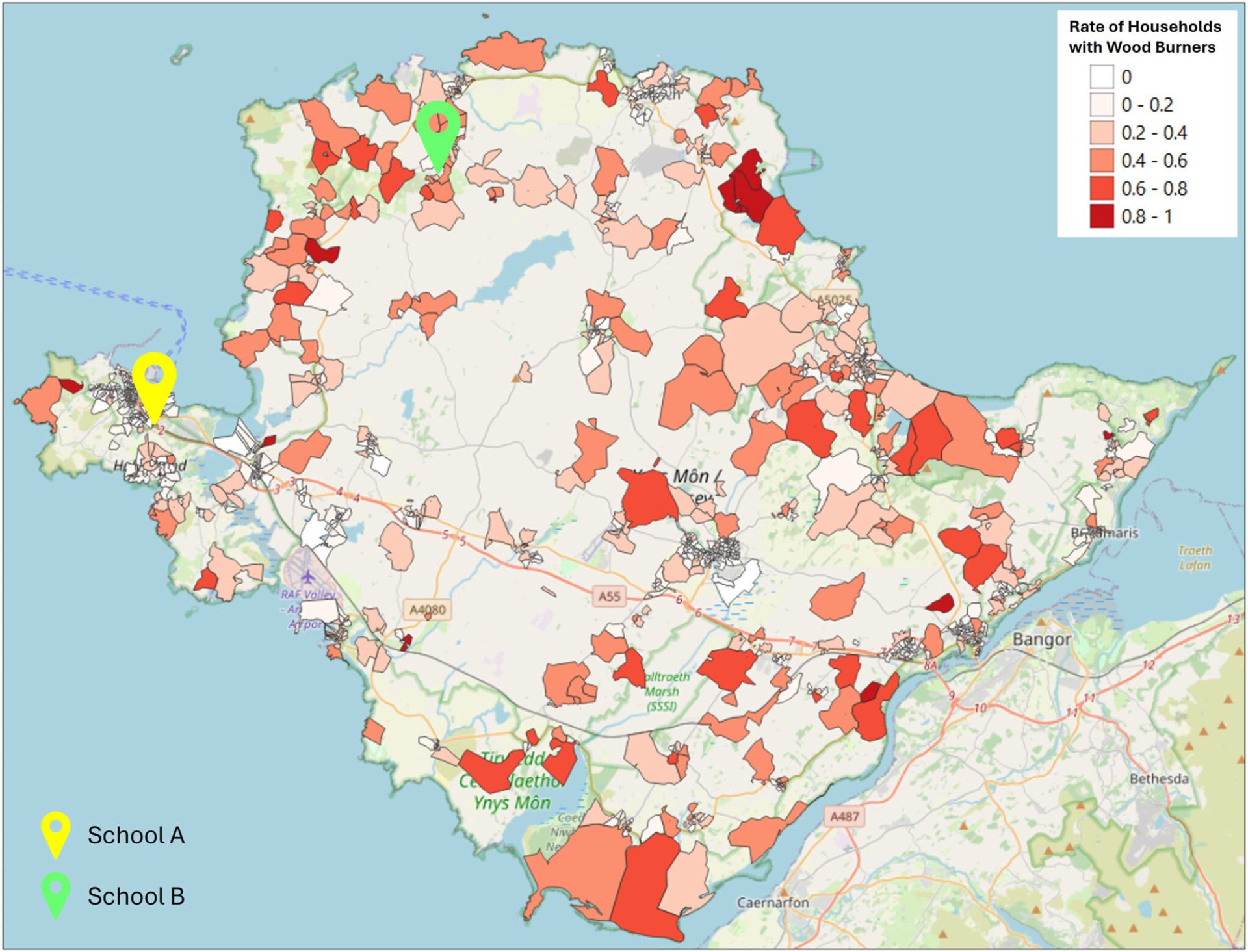
The study provided a direct comparison between a more urban school near transport links and a rural school. Contrary to expectations, children in the rural village experienced higher pollution across all settings. This was correlated with a higher reported use of wood burners (53% of households vs. 21% in the town), pointing to heating practices, potentially influenced by fuel poverty and local tradition, as a significant factor.
Commuting accounted for only 4% of a child’s day and contributed minimally to overall exposure, despite occasional short-term peaks, such as from walking past restaurant kitchens or from second-hand smoke in cars.
The researchers also found that official records may underestimate how widespread wood burning is. Comparisons between student reports and Energy Performance Certificate (EPC) data showed that decorative stoves are often not recorded. In rural, lower-income areas, wood burning was linked to both affordability pressures and cultural norms, highlighting the complex mix of economic and social factors shaping household energy choices.
The full research can be read here.